How to Style Barrel Jeans — It’s Mostly About Proportion
Barrel jeans have a reputation for being slightly difficult to style.
Most of the advice around them starts in the same place: because the leg is wide and curved, keep the top fitted. Tuck in a T-shirt, choose a cropped knit, keep everything above the waist relatively small.
That works. It’s probably the easiest place to start.
But then you see someone wearing barrel jeans with a loose shirt, an oversized blazer or a big sweater and the outfit looks completely right. Which is where the rule becomes less useful.
The difference usually has less to do with whether the top is fitted and more to do with proportion — where the volume sits, where the outfit has structure, and whether there’s somewhere for the eye to find a little definition.
Once you start noticing those things, barrel jeans become much easier to work with.
First, Look at the Shape of the Jeans
Barrel jeans aren’t simply another version of wide-leg denim.
The leg moves outward through the thigh or knee and then comes back in towards the ankle. That last part matters. A wide-leg jean tends to continue its line towards the floor; a barrel jean creates a visible curve and then closes it again.
Put on a pair with a plain T-shirt and you can see it immediately. The jeans are already doing quite a lot.
This is why a fitted top is such an easy pairing. It leaves the curved leg as the obvious shape in the outfit.
A fitted ribbed knit and barrel jeans, for example, are difficult to get very wrong. Add a simple flat or a slim ankle boot and the proportions are already clear.
For a straightforward outfit, that formula is a useful starting point.
A Roomier Top Can Work Too
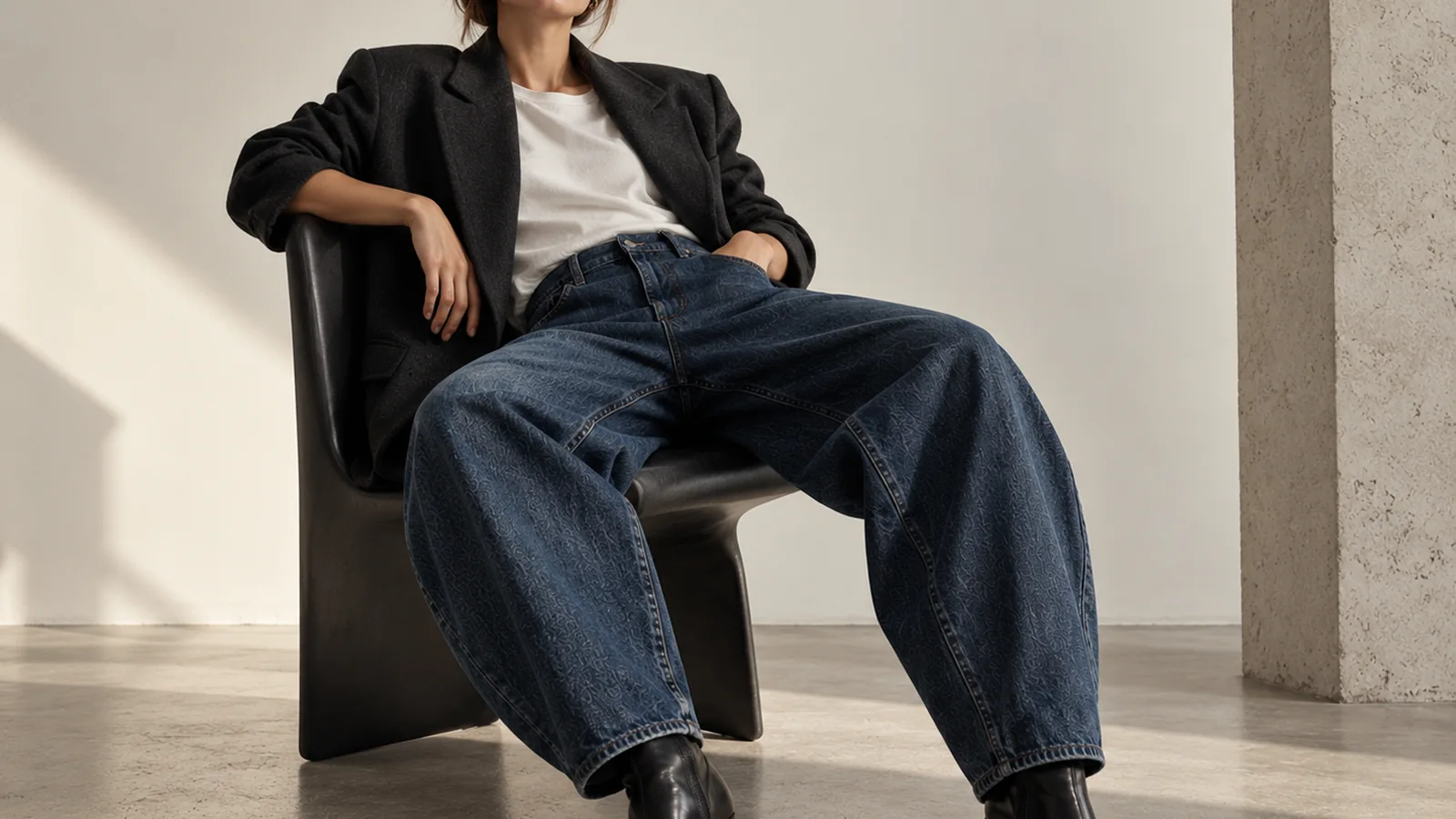
Try the same jeans with an oversized blazer.
Now there is volume above and below the waist, but it doesn’t necessarily make the outfit feel bigger. A blazer has a shoulder line. It has edges. It holds its shape.
Those things give the upper half of the outfit enough definition that the top doesn’t need to be fitted.
This is particularly easy to see with a fairly ordinary combination: barrel jeans, a simple T-shirt and a slightly oversized blazer worn open. Nothing needs to be tight. The jacket does enough.
A crisp shirt can work in much the same way. Even if the shirt itself is relaxed, the collar, cuffs and firmer fabric keep it from behaving like one large soft shape.
Here, the useful thing to notice is the structure rather than how closely the clothes sit to the body.
Sometimes a Small Adjustment Is Enough
Loose shirt, loose jeans. On paper, it sounds like exactly the combination you’re supposed to avoid.
In practice, it can depend on something as small as what happens around the waist.
Try leaving the shirt completely untucked. Then tuck just a little of the front into the waistband. Same shirt, same jeans, but suddenly there is a point where the two shapes separate.
Rolling the sleeves can make a difference too. So can leaving a few buttons open, showing the waistband, or choosing a shirt that finishes slightly higher rather than somewhere around the widest part of the jeans.
None of these changes makes the shirt fitted. They simply stop all the fabric from becoming one continuous loose shape, which is often enough to make the proportions easier to read.
And Yes, Oversized With Oversized Can Work
This is the combination that makes the usual barrel-jean advice start to fall apart.
An oversized sweater with barrel jeans can look great. It can also look as though you’ve accidentally put on two clothes that are both a size too large.
The difference isn’t always obvious until you try them together.
Length matters. A sweater that finishes around the waistband behaves very differently from one that falls well over the hips. Texture matters too. A knit with some shape of its own can hold up against the curve of the jeans better than something very soft and long.
Before changing anything, look at whether the silhouette still has some definition. If the sweater and jeans seem to merge into one large shape, notice where the sweater ends and whether either piece is dominating the outfit.
Sometimes a slight tuck, a shorter knit, pushed-up sleeves or a different shoe is enough to sort it out.
A Long Coat Can Change the Same Outfit
Now take that oversized sweater and barrel jeans and add a long coat.
A coat that runs past the hip — particularly one with a fairly clean front — gives the eye a longer line to follow. Instead of reading the sweater and jeans as two separate areas of volume, you start seeing the whole silhouette together.
This is worth checking with the coat you actually intend to wear. An outfit that seems slightly unresolved indoors can look quite different once the outer layer is on.
Don’t Treat Shoes as an Afterthought
Shoes are unusually noticeable with barrel jeans because of where the leg narrows.
With a pointed flat, ballet flat or slim boot, the shoe continues that narrower line towards the ground. The result tends to feel lighter.
Put a substantial sneaker or heavier boot underneath the same jeans and you’re adding weight back at the bottom. That can work too.
A chunky boot with barrel jeans and a structured jacket, for example, can feel deliberate because the outfit already has enough definition elsewhere. With a very loose sweater and equally loose outer layer, the same boot might simply be one heavy element too many.
Rather than starting with a list of shoes that supposedly work with barrel jeans, try changing the shoes while everything else stays the same. The difference in visual weight is usually easy to spot.
Same Jeans, Different Proportions
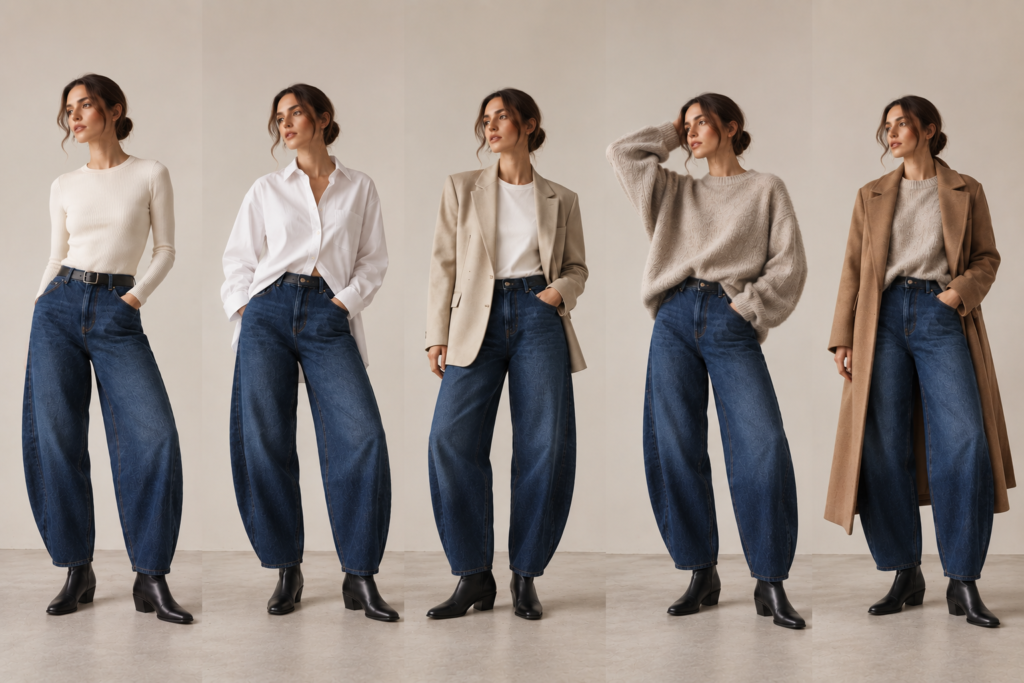
The easiest way to see these ideas is to keep the jeans the same and change one thing at a time.
A fitted knit lets the curved leg become the obvious shape. Swap it for a relaxed shirt and a small front tuck can create enough definition at the waist. Add an oversized blazer to a simple T-shirt and structure starts doing the work instead of fit.
An oversized knit pushes the experiment further: now there is volume above and below. Add a long coat over that same combination and the eye begins to follow the longer outer line instead.
Seen side by side, the differences are less about finding the correct top and more about noticing how each change shifts the balance of the outfit.
What If They Still Don’t Look Right?
Before buying another top to make barrel jeans work, look at the jeans themselves.
Barrel cuts vary a lot.
Some curve quite dramatically from high on the thigh. Others stay relatively straight before widening lower down. Rise changes the proportions again, as does the point where the hem meets the ankle.
A pair that looks great on one person can feel oddly placed on another even when they’re technically the correct size.
That doesn’t mean barrel jeans aren’t for you. It may just mean those barrel jeans aren’t for you.
If you’ve tried several tops, jackets and shoes and the same pair still feels awkward, try a different rise, a softer curve or another length before deciding the problem is your styling.
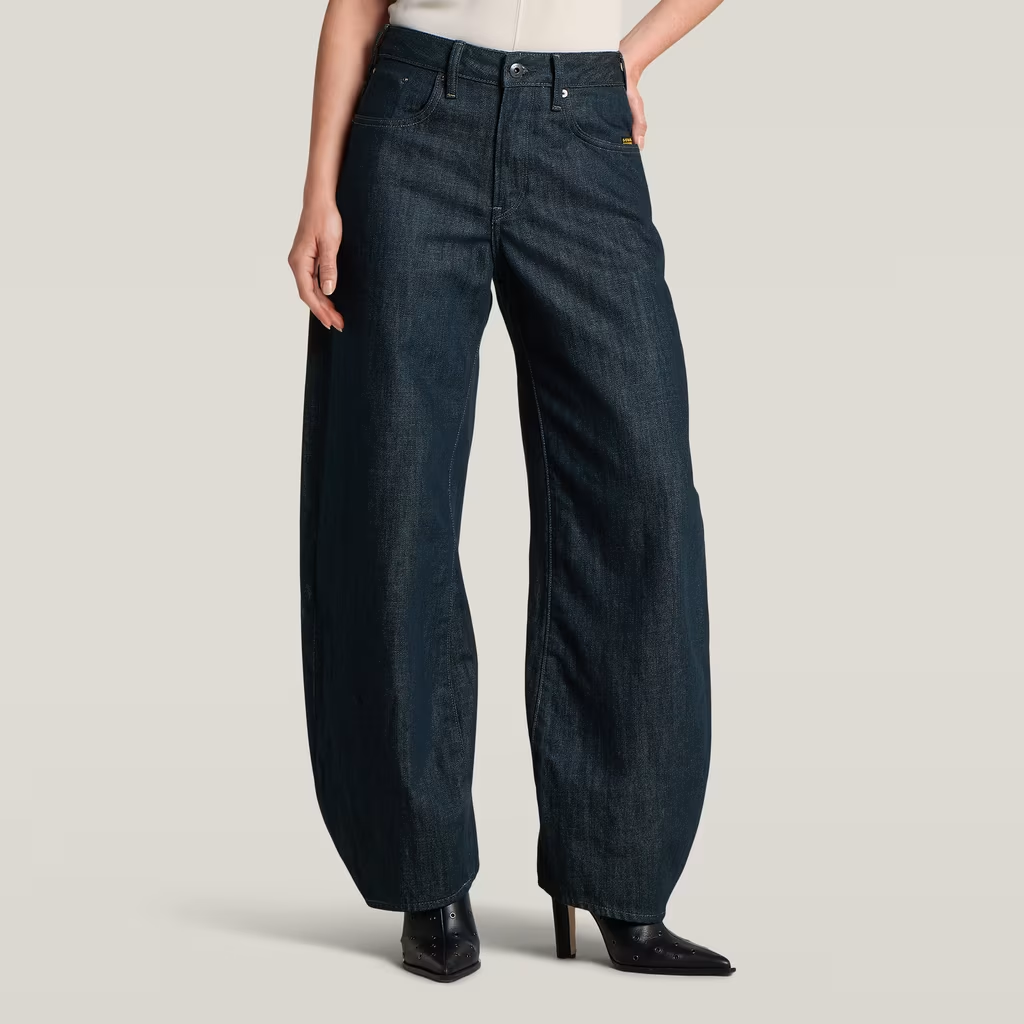
Barrel 3D Loose Jeans
A more pronounced take on the barrel shape, with enough curve through the leg to make proportion part of the look rather than something to disguise.
G-Star RAW · $190
Affiliate note: We may earn a commission if you purchase through this link, at no extra cost to you.
The ARANEMI Take
The fitted-top rule exists for a reason. It gives the volume of barrel jeans an easy counterpoint, and for a simple outfit it works very well.
But you don’t need to build every outfit around that contrast.
A relaxed top might only need a visible waistband. An oversized blazer can rely on structure instead of closeness to the body. A large knit may work because of where it ends. A long coat can change the proportions of everything underneath it.
There isn’t one correct amount of volume. What matters is being able to see where the shape is coming from and what the rest of the outfit is doing with it.
That is a much more useful starting point than trying to remember a rule for every top, jacket or pair of shoes in your wardrobe.